Welcome to Accounting 101
Everything a college student needs to know about financial accounting
Accounting is the language of business. Whether you're pursuing a business degree, starting a side hustle, or just want to understand how companies report their finances — this guide has you covered.
Work through each topic in order or jump to any chapter using the sidebar.
Why study accounting?
Even if you're not an accounting major, understanding basic financial concepts will help you:
- Understand company financial health before investing
- Manage personal and business budgets
- Interpret annual reports and financial news
- Communicate with finance teams in any career
- Start and run a small business or startup
How to Use This Guide Effectively
Treat this app like a mini-course, not just a reference page. The topics are sequenced to build your understanding step by step.
Read a chapter actively
After each section, pause and write one real-world example in your own words (for example, a debit/credit transaction from student life or a small business).
Take the quiz, then review misses
Use quiz explanations to identify weak spots and revisit only those chapters for efficient review.
Need the easiest version first?
Start with Kid Mode. It teaches the same accounting ideas with story language and tiny steps before the full technical chapters.
Kid Mode: Accounting With a Lemonade Stand
Teach it like you're 10: simple words, clear steps, real examples
Imagine you run a lemonade stand called Sunny Sips. Accounting is just your way of keeping score so you always know if your stand is healthy.
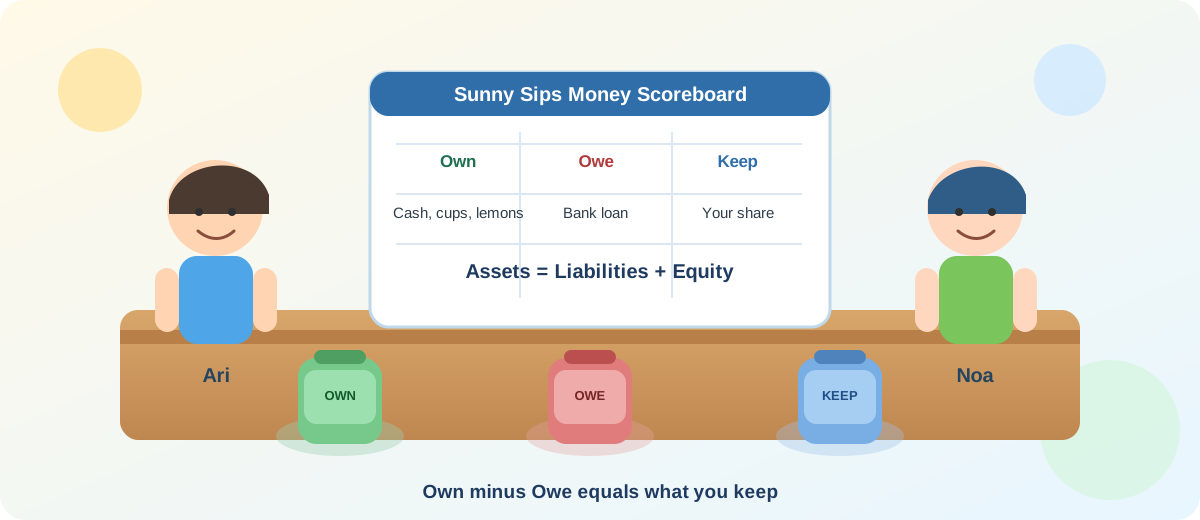
Cartoon memory trick: What you own goes in the green jar, what you owe goes in the red jar, and what is truly yours goes in the blue jar.
What is accounting?
A money scoreboard. It tells what you have, what you owe, and how much you earned.
Why use it?
So you do not guess. You can answer: "Can I buy more lemons?" with facts.
What is a transaction?
Any money event: buying cups, making a sale, paying rent, borrowing money.
Big Words in Kid Words
| Accounting Word | Kid-Friendly Meaning | Sunny Sips Example |
|---|---|---|
| Asset | Something useful you own | Cash, lemons, pitcher, table |
| Liability | Money you still owe | Borrowed $50 from your uncle |
| Equity | Your true share after debts | What belongs to you after paying what you owe |
| Revenue | Money earned from customers | Selling cups of lemonade |
| Expense | Money spent to run the stand | Cups, sugar, sign supplies |
The 3 Book System (Most Important!)
Beginners mix these up. Keep this mental picture: labels, then diary, then folders.
| Book | Kid Name | What it does | Question it answers |
|---|---|---|---|
| Chart of Accounts | Label list | List of all account names/numbers | "What is the correct account name?" |
| General Journal | Diary | Records each transaction by date | "What happened today?" |
| General Ledger | Folders | Groups entries by account with running balance | "How much cash do we have now?" |
How One Sale Moves Through Accounting
Event: A customer pays $8 cash for lemonade.
Step 1 (COA): Choose account names: Cash and Service Revenue.
Step 2 (Journal): Record entry: Debit Cash 8, Credit Service Revenue 8.
Step 3 (Ledger): Add $8 to Cash account and $8 to Revenue account balances.
Mini Story: 5 Days at Sunny Sips
Follow this like a cartoon timeline. Notice every event touches at least two accounts.
| Day | What happened | Kid explanation | Entry |
|---|---|---|---|
| Day 1 | Shareholders buy $100 of stock | The company got cash from shareholders | Dr Cash 100 / Cr Common Stock 100 |
| Day 2 | Buy lemons for $20 cash | Cash down, supplies up | Dr Supplies 20 / Cr Cash 20 |
| Day 3 | Sell lemonade for $30 cash | You earned money | Dr Cash 30 / Cr Revenue 30 |
| Day 4 | Pay helper $10 | Cost of running stand | Dr Wages Expense 10 / Cr Cash 10 |
| Day 5 | Borrow $40 from bank | Cash up, debt up | Dr Cash 40 / Cr Notes Payable 40 |
Kid Checks (Try Before Seeing Answers)
Think first, then open each answer.
Answer
Chart of Accounts.Answer
General Journal.Answer
General Ledger.Answer
Supplies (debit) and Cash (credit).Interactive Builder: Make the Entry
Pick a scenario and build the journal entry yourself. Choose the debit account, credit account, and amount.
1. Introduction to Accounting
What it is, who uses it, and the two main branches
Accounting is the systematic process of recording, summarizing, analyzing, and reporting financial transactions of a business or individual. It produces information that helps stakeholders make informed decisions.
Two Main Branches
| Branch | Audience | Purpose | Example |
|---|---|---|---|
| Financial Accounting | External (investors, banks) | Report past performance | Annual report, 10-K filing |
| Managerial Accounting | Internal (management) | Aid future decisions | Budget, cost analysis |
Key Principles (GAAP)
In the United States, accounting follows Generally Accepted Accounting Principles (GAAP), issued by the Financial Accounting Standards Board (FASB). Key principles include:
- Entity principle — business finances separate from shareholders' personal finances
- Going concern — assume the business will continue indefinitely
- Cost principle — record assets at their original purchase cost
- Revenue recognition — record revenue when it is earned, not when cash is received
- Matching principle — record expenses in the same period as the revenue they helped generate
- Conservatism — when in doubt, record losses early, gains only when certain
Practice Questions
Q1. What is the difference between financial accounting and managerial accounting?
Q2. A company pays rent in December but the rent covers January. Under GAAP, in which month is the expense recorded?
Q3. True or false: Under accrual accounting, revenue is recorded when cash is received.
Q4. Which US body issues the GAAP standards that businesses must follow?
2. The Accounting Equation
The foundation of all of accounting
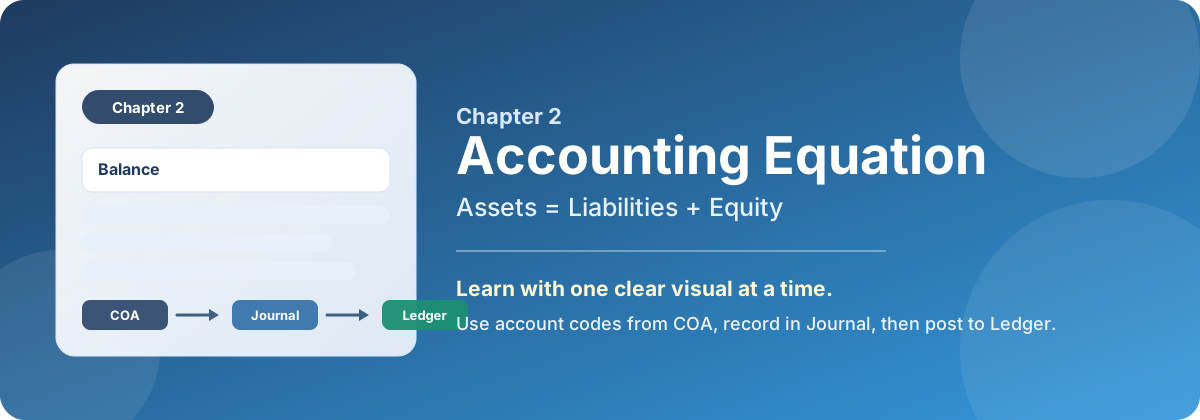
Every transaction in accounting is built on one fundamental equation:
This equation must always stay balanced. Every single transaction affects at least two accounts but the equation never breaks — this is called double-entry accounting.
What each term means
| Term | Definition | Examples |
|---|---|---|
| Assets | Resources owned by the company that have economic value | Cash, inventory, equipment, buildings, accounts receivable |
| Liabilities | Obligations owed to outside parties (creditors) | Loans, accounts payable, accrued salaries, taxes owed |
| Stockholders' Equity | Residual interest that belongs to shareholders after liabilities are paid | Common stock, additional paid-in capital, retained earnings |
Expanded Accounting Equation
For corporations, retained earnings changes each period by: + Revenue − Expenses − Dividends.
Example transactions
| Transaction | Assets | Liabilities | Equity | Still balanced? |
|---|---|---|---|---|
| Issue common stock for $10,000 cash | +$10,000 | — | +$10,000 | ✅ Yes |
| Borrow $5,000 from bank | +$5,000 | +$5,000 | — | ✅ Yes |
| Buy $2,000 supplies on credit | +$2,000 | +$2,000 | — | ✅ Yes |
| Earn $3,000 service revenue on account | +$3,000 (A/R) | — | +$3,000 | ✅ Yes |
| Pay $800 rent expense | −$800 | — | −$800 | ✅ Yes |
Practice Questions
Q1. A company borrows $10,000 from a bank. How does this affect the accounting equation?
Q2. If total liabilities are $14,000 and stockholders' equity is $21,000, what are total assets?
Q3. A business pays $600 for electricity. What effect does this have on the equation?
Q4. True or false: A single transaction can affect only one side of the accounting equation.
3. Types of Accounts
The five money buckets every beginner should know
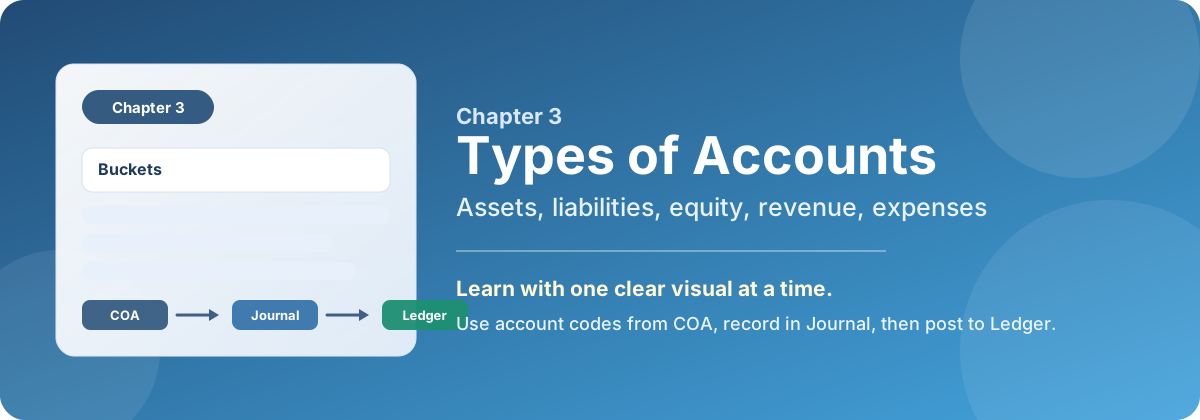
Every transaction goes into one or more account buckets. If you can identify the right bucket, accounting becomes much easier.
Bucket Map (simple view)
| Account Type | Kid-Friendly Meaning | Normal Balance | Easy Example |
|---|---|---|---|
| Assets | Things your business owns/controls | Debit | Cash, supplies, equipment |
| Liabilities | Money your business owes others | Credit | Accounts payable, loan payable |
| Equity | Shareholders' true share after debts | Credit | Common stock, retained earnings |
| Revenue | Money earned from customers | Credit | Service revenue, sales revenue |
| Expenses | Costs to run the business | Debit | Rent, wages, utilities |
Quick Sorting Practice
Try to name each bucket before checking the answer in your head.
| Item | Correct Type | Why |
|---|---|---|
| Cash in bank | Asset | You own it and can use it. |
| Bill from supplier not paid yet | Liability | You owe someone else. |
| Cash from issuing stock | Equity | Shareholders' claim in the business increases. |
| Money earned from customers | Revenue | Income from doing business work. |
| Monthly rent payment | Expense | Cost of operating the business. |
Current vs. Long-Term (kid words)
Assets and liabilities are also grouped by timing: soon (within a year) or later (more than a year).
| Group | Meaning | Asset Examples | Liability Examples |
|---|---|---|---|
| Current | Used/paid within about 12 months | Cash, accounts receivable, inventory | Accounts payable, short-term notes |
| Long-Term | Stays beyond 12 months | Equipment, building, patent | Mortgage, long-term loan |
Practice Questions
Q1. Using DEALER, which three account types normally have a debit balance?
Q2. Classify each item — Asset, Liability, Equity, Revenue, or Expense: (a) Accounts Payable (b) Equipment (c) Service Revenue (d) Wages Expense (e) Retained Earnings.
Q3. Is Unearned Revenue an asset or a liability? Explain why.
Q4. What is the difference between a current asset and a long-term asset?
4. Debits & Credits
The rule system that makes double-entry accounting work
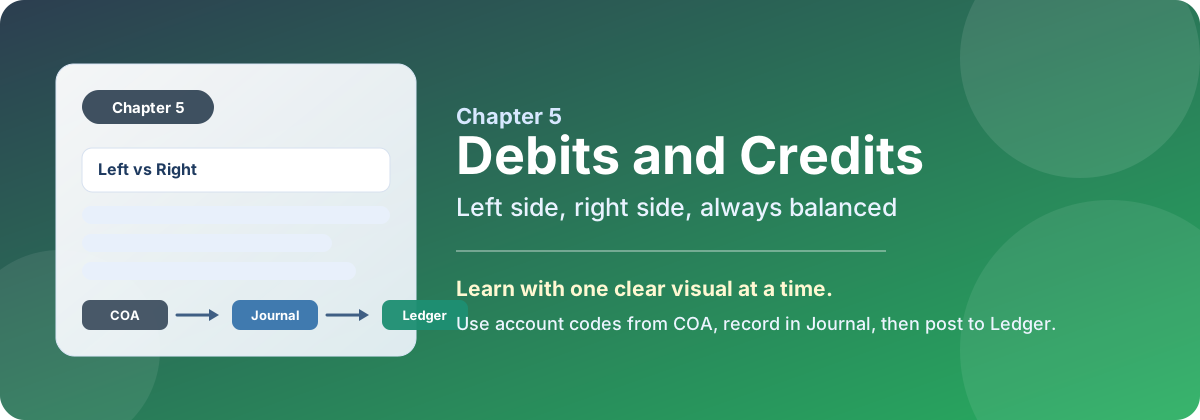
Debits and credits are the mechanics of accounting. They are not "good" or "bad" and they are not the same as "money in" and "money out." They simply indicate whether an amount is recorded on the left side (debit) or right side (credit) of an account.
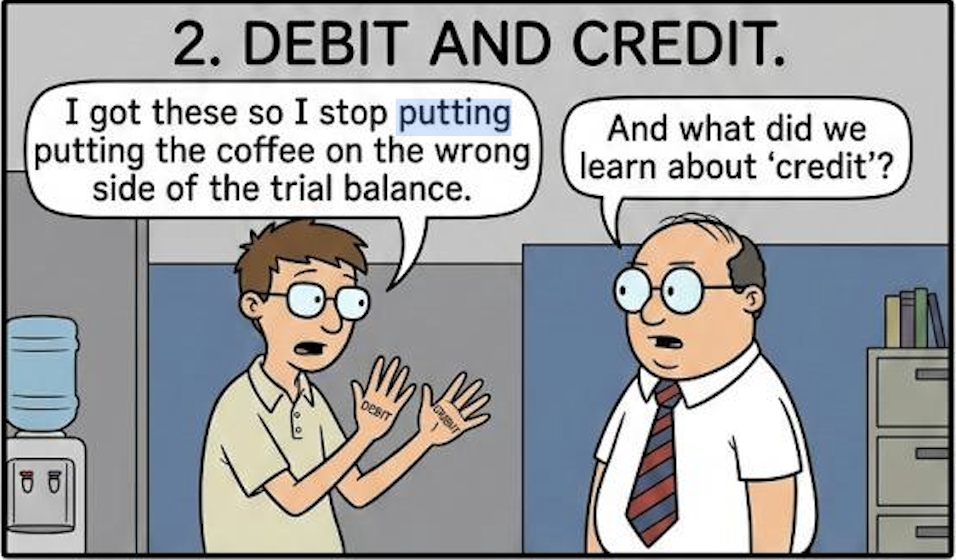
Debit = left side.
Credit = right side.
Then ask: "Does this account type increase on the left or on the right?"
Normal Balance Pattern (DEALER)
Use the memory aid DEALER: Dividends, Expenses, Assets have normal Debit balances; Liabilities, Equity, Revenue have normal Credit balances.
| Account Type | Increase With | Decrease With | Normal Balance |
|---|---|---|---|
| Assets | Debit | Credit | Debit |
| Liabilities | Credit | Debit | Credit |
| Equity | Credit | Debit | Credit |
| Revenue | Credit | Debit | Credit |
| Expenses | Debit | Credit | Debit |
How to Decide Debits and Credits in 4 Steps
Identify the accounts involved
Use your Chart of Accounts names (Cash, Accounts Receivable, Unearned Revenue, etc.).
Classify each account type
Is each one an Asset, Liability, Equity, Revenue, or Expense?
Determine increase or decrease
Ask what happened to each account: did it go up or down?
Apply rules and balance
Choose Debit/Credit based on account type + direction, then confirm Debits = Credits.
Transaction Walkthroughs
| Transaction | What Increased | What Decreased | Correct Entry |
|---|---|---|---|
| Buy equipment for $2,000 cash | Equipment (Asset) | Cash (Asset) | Dr Equipment 2,000 / Cr Cash 2,000 |
| Provide services for $900 cash | Cash (Asset) | — | Dr Cash 900 / Cr Service Revenue 900 |
| Pay $450 on Accounts Payable | — | Cash (Asset), Accounts Payable (Liability) | Dr Accounts Payable 450 / Cr Cash 450 |
| Receive $600 in advance from a customer | Cash (Asset) | — | Dr Cash 600 / Cr Unearned Revenue 600 |
T-Account Visualizer
T-accounts help you see running debits and credits by account.
Common stock issued 10,000
Cash sales 1,200
Rent paid 800
Supplies 300
Paid vendor 450
Inventory on credit 1,000
Cash revenue 1,200
On-account revenue 2,000
Practice Questions
Q1. You pay $750 cash for office supplies. Which account is debited and which is credited?
Q2. True or false: A credit always means money is leaving the business.
Q3. Increase a liability — do you debit or credit it?
Q4. If total debits in a journal entry are $2,500, what must total credits equal?
5. Chart of Accounts
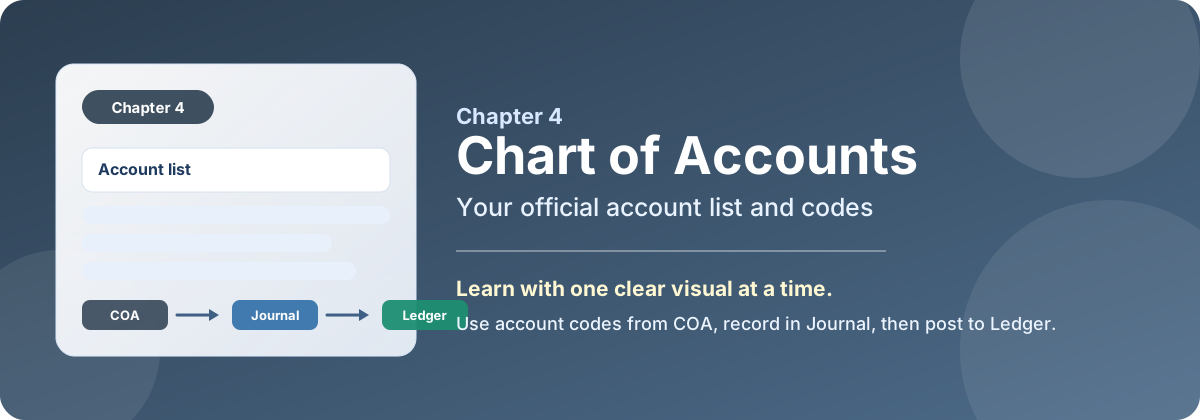
Your business's master list of all accounts — like a menu for recording transactions
Before you can record any transaction, you need a Chart of Accounts (COA) — a numbered directory of every account your business uses. Think of it like the contacts list on your phone: it organizes everyone (every account) in one place so you can find them fast.
How accounts are numbered
Accounts are grouped by type and given a number range. This makes it easy to know what type of account you're looking at just from its number:
| Number Range | Account Type | Examples |
|---|---|---|
| 1000–1999 | Assets | 1010 Cash, 1100 Accounts Receivable, 1500 Equipment |
| 2000–2999 | Liabilities | 2010 Accounts Payable, 2100 Notes Payable, 2300 Unearned Revenue |
| 3000–3999 | Equity | 3010 Common Stock, 3900 Retained Earnings |
| 4000–4999 | Revenue | 4010 Service Revenue, 4020 Sales Revenue |
| 5000–5999 | Expenses | 5010 Rent Expense, 5020 Salaries Expense, 5030 Utilities Expense |
Note: numbering systems vary by company. The ranges above are a common convention, not a law.
Example: Small Business Chart of Accounts
| Account # | Account Name | Type | What it tracks |
|---|---|---|---|
| 1010 | Cash | Asset | Money in your bank account |
| 1100 | Accounts Receivable | Asset | Money customers owe you |
| 1400 | Supplies | Asset | Office or shop supplies on hand |
| 1500 | Equipment | Asset | Computers, machinery, tools |
| 2010 | Accounts Payable | Liability | Bills you owe but haven't paid |
| 2100 | Notes Payable | Liability | Loans from the bank |
| 3010 | Common Stock | Equity | Money received from issuing shares |
| 3900 | Retained Earnings | Equity | Profits kept in the business |
| 4010 | Service Revenue | Revenue | Money earned from services |
| 5010 | Rent Expense | Expense | Monthly rent payments |
| 5020 | Salaries Expense | Expense | Employee wages |
| 5030 | Utilities Expense | Expense | Electric, water, internet bills |
Practice Questions
Q1. What number range typically represents liability accounts in a standard Chart of Accounts?
Q2. Why is having a Chart of Accounts important for a business?
Q3. Account #5030 in a standard COA is most likely what type of account?
Q4. True or false: Every company must use the exact same Chart of Accounts structure.
6. General Journal
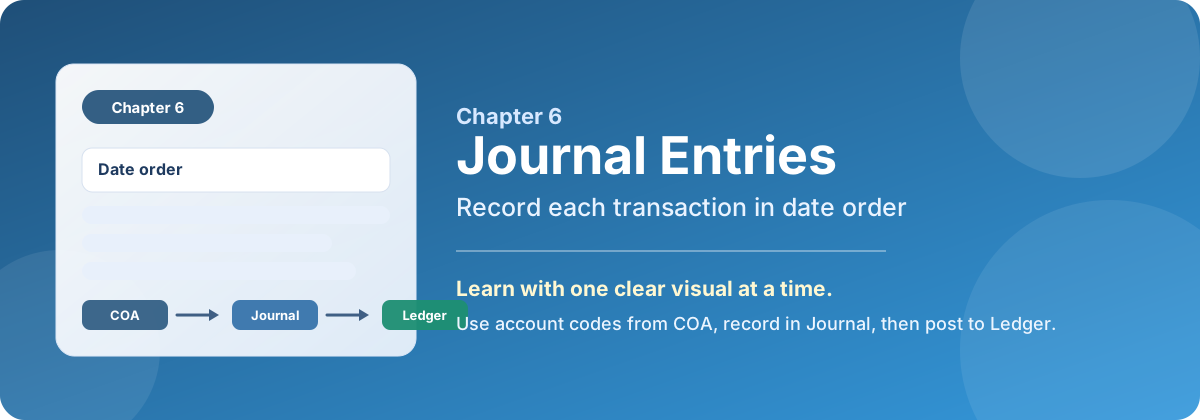
The chronological record where every transaction is first written down
What is a Journal Entry?
A journal entry is the first formal record of a financial transaction. Every time something financial happens — a sale, a payment, a purchase — you capture it as a journal entry before anything else. It uses the debit/credit system and must always balance: total debits must equal total credits.
What is the General Journal?
The General Journal is the book (or digital log) that holds all journal entries in chronological order. It is the starting point of the accounting process — every transaction enters the system here first, then gets posted to the General Ledger.
Standard Journal Entry Format
Every journal entry has four parts: date, account names (debit first, credit indented), amounts, and a short narration explaining the transaction.
| Date | Account | Debit | Credit |
|---|---|---|---|
| Jan 5 | Cash | 10,000 | |
| Common Stock | 10,000 | ||
| → Issued common stock for $10,000 cash | |||
Common Journal Entry Examples
| Transaction | Debit | Credit | Why |
|---|---|---|---|
| Owner invests $8,000 cash | Cash 8,000 | Common Stock 8,000 | Asset up; Equity up |
| Buy supplies on credit, $400 | Supplies 400 | Accounts Payable 400 | Asset up; Liability up |
| Earn $1,200 cash from services | Cash 1,200 | Service Revenue 1,200 | Asset up; Revenue up |
| Pay $600 monthly rent | Rent Expense 600 | Cash 600 | Expense up; Asset down |
| Customer pays $500 invoice owed | Cash 500 | Accounts Receivable 500 | Asset swap — cash in, receivable out |
| Receive $900 in advance for future work | Cash 900 | Unearned Revenue 900 | Asset up; Liability up (service still owed) |
Compound Journal Entry
When a transaction affects more than two accounts, it is called a compound entry. Debits still must equal credits.
| Date | Account | Debit | Credit |
|---|---|---|---|
| Feb 1 | Equipment | 9,000 | |
| Cash | 4,000 | ||
| Notes Payable | 5,000 | ||
| → Purchased equipment; paid $4,000 cash and financed $5,000 with a bank loan | |||
From Journal to Ledger
Once a journal entry is recorded, each line is posted to the corresponding account in the General Ledger. This is how account balances stay current.
Identify accounts and amounts
Use your Chart of Accounts to select the correct account names and numbers.
Write the journal entry
Record the date, debit(s), credit(s), and narration in the General Journal.
Post to the General Ledger
Transfer each debit and credit line to the matching account's ledger page to update its running balance.
Practice Questions
Q1. What are the four required parts of a standard journal entry?
Q2. A customer pays your business $2,000 cash for work you completed today. Write the journal entry.
Q3. What is a compound journal entry?
Q4. True or false: In a journal entry, credit lines are written before debit lines.
7. The General Ledger
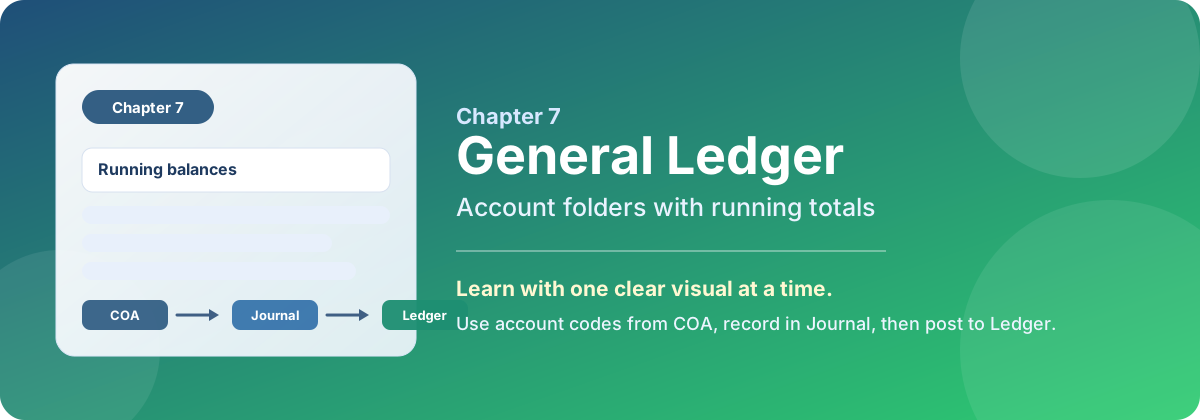
Your business's master scoreboard — one running score for every account
What is the General Ledger?
The General Ledger is the master record of your business. After every journal entry is written, each line gets copied ("posted") into the General Ledger, which keeps a separate running balance for every account — Cash, Rent Expense, Service Revenue, and so on.

What does "Posting" mean?
Posting is just the act of copying a journal entry's debit and credit amounts into the correct accounts in the General Ledger. Nothing changes — you're just moving the same information from date order into account order.
The T-Account — the Ledger's building block
Each account in the General Ledger is shown as a T-account — shaped like the letter T. The left side holds debits, the right side holds credits. The difference between the two sides is the account's balance.
amounts added here
amounts added here
Step-by-step: Posting a real example
Lemonade Stand Co. has three transactions in June. Here's how they move from the General Journal into the General Ledger.
Step 1 — The General Journal (date order):
| Date | Account | Debit | Credit |
|---|---|---|---|
| Jun 1 | Cash | 5,000 | |
| Common Stock | 5,000 | ||
| → Owner put in $5,000 to start the business | |||
| Jun 3 | Supplies | 800 | |
| Cash | 800 | ||
| → Bought lemons and cups for $800 cash | |||
| Jun 10 | Cash | 2,000 | |
| Service Revenue | 2,000 | ||
| → Sold lemonade and earned $2,000 cash | |||
Step 2 — The General Ledger (account order):
Each journal entry line goes to its matching account. Cash appeared three times — all three land in the Cash T-account.
Jun 1 — 5,000
Jun 10 — 2,000
Balance: 6,200
Jun 3 — 800
Jun 1 — 5,000
Balance: 5,000
Jun 3 — 800
Balance: 800
Jun 10 — 2,000
Balance: 2,000
Why does the General Ledger matter?
| Question | Where you look | What you find |
|---|---|---|
| How much cash do we have? | Cash account in the Ledger | Current cash balance |
| How much do customers owe us? | Accounts Receivable in the Ledger | Total outstanding receivables |
| How much have we spent on rent? | Rent Expense in the Ledger | Total rent paid so far |
| How much revenue did we earn? | Service Revenue in the Ledger | Total revenue for the period |
From Ledger to Trial Balance
Once all transactions are posted, you list every account's balance in a Trial Balance. If the total of all debit balances equals the total of all credit balances, your books are correct and ready for financial statements.
Record in the General Journal
Write every transaction as a journal entry with debits and credits.
Post to the General Ledger
Copy each line to its account. Every account builds up a running balance.
Prepare a Trial Balance
List all ledger balances. Total debits must equal total credits — if they do, you're balanced!
Build Financial Statements
Use the ledger balances to create the Income Statement, Balance Sheet, and other reports.
Practice Questions
Q1. What does 'posting' mean in accounting?
Q2. A Cash T-account has $9,000 on the debit side and $3,400 on the credit side. What is the Cash balance?
Q3. What is the difference between the General Journal and the General Ledger?
Q4. What document is prepared after posting all transactions to the General Ledger, and what does it verify?
8. Financial Statements
The Core Four - beginner version of the full reporting set
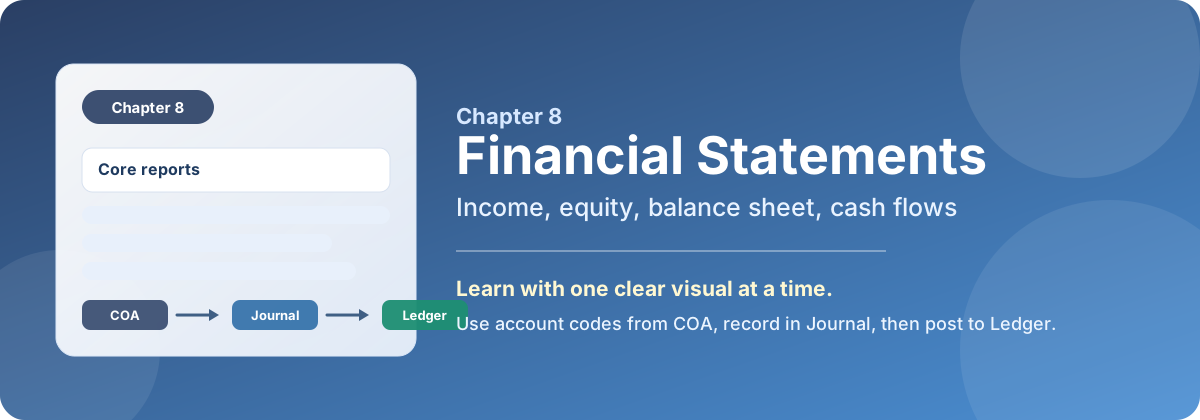
A complete beginner-friendly set includes four statements, not three. The Statement of Stockholders' Equity is also part of the core package.
What each statement answers
| Statement | Main question | Time view |
|---|---|---|
| Income Statement | "Did we make a profit?" | Over a period |
| Statement of Stockholders' Equity | "Why did equity change?" | Over a period |
| Balance Sheet | "What do we own and owe right now?" | At one date |
| Statement of Cash Flows | "Where did cash come from and go?" | Over a period |
Statement 1: Income Statement (Profit & Loss)
Shows revenues minus expenses over the period. The result is net income (profit) or net loss.
For the Year Ended December 31, 2025
Statement 2: Statement of Stockholders' Equity
Explains how equity changed during the period using beginning equity, plus net income, minus dividends, plus/minus stock transactions.
For the Year Ended December 31, 2025
Statement 3: Balance Sheet
A snapshot at one date. It must balance: Assets = Liabilities + Equity.
As of December 31, 2025
Statement 4: Statement of Cash Flows
Shows how cash moved during the period. It is split into three activities:
| Section | What it covers | Examples |
|---|---|---|
| Operating | Day-to-day business operations | Cash from customers, salaries paid, rent paid |
| Investing | Buying/selling long-term assets | Equipment purchase, sale of investments |
| Financing | Debt and equity transactions | Loan proceeds, debt repayment, stock issuance, dividends paid |
For the Year Ended December 31, 2025
How the four statements connect
Income Statement gives Net Income
In this example, net income is $25,000.
Net Income flows into Statement of Stockholders' Equity
That statement explains why equity moved from beginning to ending balance.
Ending Equity flows into Balance Sheet
Balance Sheet uses that ending equity amount at the reporting date.
Cash Flows explains the change in cash
It helps explain why profit and cash may differ.
Practice Questions
Q1. Which financial statement answers the question 'Did we make a profit this period?'
Q2. A company has $85,000 revenue and $60,000 total expenses. What is net income? Which statement shows this?
Q3. What is the key difference between the Income Statement and the Balance Sheet in terms of time?
Q4. Where does net income from the Income Statement flow next?
9. Adjusting Entries (Accruals and Deferrals)
Period-end updates so revenue and expense are recorded in the correct month
Adjusting entries are made at the end of the period to match accounting records with economic reality. They are required under accrual accounting and the matching principle.
Four common adjusting entry types
| Type | What happened | Adjusting Entry | Why |
|---|---|---|---|
| Deferred Expense | Prepaid insurance was used | Dr Insurance Expense / Cr Prepaid Insurance | Move used benefit from asset to expense |
| Accrued Expense | Employees earned wages not yet paid | Dr Wages Expense / Cr Wages Payable | Record expense in the month incurred |
| Accrued Revenue | Service performed but not yet billed | Dr Accounts Receivable / Cr Service Revenue | Record revenue when earned |
| Deferred Revenue | Cash received earlier is now earned | Dr Unearned Revenue / Cr Service Revenue | Move obligation to earned revenue |
Mini example: one month of prepaid insurance used
You paid $1,200 for a 12-month policy. At month-end, one month is used ($100).
Effect: expense goes up (net income down), prepaid asset goes down, and the period reports are more accurate.
Practice Questions
Q1. True or false: Adjusting entries always involve a cash transaction.
Q2. Your company paid $2,400 for a 12-month insurance policy. At the end of month 1, what adjusting entry is needed?
Q3. Employees earned $1,800 in wages during December but payday is January 3. What adjusting entry is made at December 31?
Q4. What is the difference between a deferred expense and an accrued expense?
10. Revenue Recognition vs Cash Collection
Revenue is recognized when earned, not when cash arrives
In accrual accounting, the timing of cash and the timing of revenue can be different. The key question is: Has the service/product been delivered?
Timing map
| Situation | When cash is received | When revenue is recorded | Main account used |
|---|---|---|---|
| Customer pays before work | Now | Later, when work is done | Unearned Revenue (liability) |
| Work done before customer pays | Later | Now, when work is done | Accounts Receivable (asset) |
| Cash and work same day | Now | Now | Cash + Revenue |
Two fast journal examples
| Scenario | Entry at cash date | Entry at service date |
|---|---|---|
| $500 collected in advance | Dr Cash 500, Cr Unearned Revenue 500 | Dr Unearned Revenue 500, Cr Service Revenue 500 |
| $700 service done on account | No cash entry | Dr Accounts Receivable 700, Cr Service Revenue 700 |
Practice Questions
Q1. A client pays your business $1,500 in advance for work to be done next month. What account is credited at the time of payment?
Q2. True or false: Under accrual accounting, revenue is always recorded when cash is received.
Q3. You complete $900 of consulting work on credit. The client will pay next week. What journal entry do you record today?
Q4. When Unearned Revenue is later earned, what journal entry is made?
11. Depreciation and Amortization
Spread long-term asset cost across useful life
Depreciation (for tangible assets) and amortization (for intangible assets) allocate cost over time instead of expensing everything on purchase day.
Depreciation vs amortization
| Topic | Depreciation | Amortization |
|---|---|---|
| Used for | Tangible assets (equipment, vehicles) | Intangible assets (patents, software rights) |
| Typical entry | Dr Depreciation Expense / Cr Accumulated Depreciation | Dr Amortization Expense / Cr Accumulated Amortization |
| Cash impact at period end | No cash outflow | No cash outflow |
Straight-line depreciation example
Machine cost = $12,000, salvage value = $2,000, useful life = 5 years.
Year-end entry: Dr Depreciation Expense 2,000 and Cr Accumulated Depreciation 2,000.
Practice Questions
Q1. A delivery truck costs $28,000, has a $3,000 salvage value, and a 5-year useful life. What is the annual straight-line depreciation?
Q2. True or false: Recording depreciation expense reduces the cash balance.
Q3. What account is credited when recording depreciation, and why is a separate account used instead of crediting the asset directly?
Q4. What is the difference between depreciation and amortization?
12. Financial Ratio Basics
Simple ratios that help beginners read statements faster
Ratios turn big financial statements into quick signals. They help answer: liquidity, profitability, and risk.
Starter ratio set
| Ratio | Formula | Question answered |
|---|---|---|
| Current Ratio | Current Assets / Current Liabilities | Can we pay short-term bills? |
| Gross Margin | (Sales - COGS) / Sales | How much is left after product cost? |
| Net Profit Margin | Net Income / Sales | How much profit per $1 of sales? |
| Debt-to-Equity | Total Liabilities / Stockholders' Equity | How leveraged is the company? |
| Return on Assets (ROA) | Net Income / Average Total Assets | How efficiently assets produce profit? |
Quick worked example
If current assets are $50,000 and current liabilities are $25,000:
Simple read: the business has $2 of current assets for each $1 of short-term obligations.
Practice Questions
Q1. Current assets = $80,000 and current liabilities = $32,000. What is the current ratio and what does it mean?
Q2. A company has net income of $18,000 and total sales of $120,000. What is the net profit margin?
Q3. Why is it dangerous to rely on a single ratio when analysing a business?
Q4. Which ratio measures how much a company relies on debt versus equity to finance its operations?
Knowledge Check
Test your understanding of accounting basics — 15 questions
Glossary of Key Terms
Quick-reference definitions for accounting vocabulary
- Accounts Payable (AP)
- Amounts a company owes to suppliers for goods/services received but not yet paid for.
- Accounts Receivable (AR)
- Amounts customers owe to the company for goods/services delivered but not yet paid for.
- Accrual Accounting
- Recording revenues when earned and expenses when incurred, regardless of cash flow.
- Adjusting Entries
- Journal entries made at period-end to ensure revenues and expenses are recorded in the correct period.
- Amortization
- The systematic allocation of an intangible asset's cost over its useful life.
- Assets
- Resources owned or controlled by a company that have future economic value.
- Balance Sheet
- Financial statement showing assets, liabilities, and equity at a specific date.
- Cost of Goods Sold (COGS)
- The direct cost of inventory items that were sold during the period.
- Chart of Accounts
- A numbered list of all accounts used by a company, organized by category.
- Closing Entries
- Entries that zero out temporary accounts (revenues, expenses) and transfer balances to Retained Earnings.
- Credit (Cr)
- An entry on the right side of a T-account. Increases liabilities, equity, and revenue; decreases assets and expenses.
- Current Ratio
- Current Assets divided by Current Liabilities; indicates short-term liquidity strength.
- Debit (Dr)
- An entry on the left side of a T-account. Increases assets and expenses; decreases liabilities, equity, and revenue.
- Debt-to-Equity Ratio
- Total Liabilities divided by Stockholders' Equity; shows leverage and financing risk.
- Depreciation
- The systematic allocation of a long-term asset's cost over its useful life.
- Double-Entry Accounting
- Every transaction affects at least two accounts; total debits always equal total credits.
- Equity
- The shareholders' residual interest in assets after subtracting liabilities (net assets).
- Expense
- The cost of resources consumed to generate revenue during a period.
- GAAP
- Generally Accepted Accounting Principles — the standard framework for financial reporting in the US.
- General Journal
- The book of original entry where all transactions are first recorded chronologically.
- General Ledger
- The master record containing all account balances, organized by account type.
- Gross Margin
- (Sales minus COGS) divided by Sales; shows profitability before operating expenses.
- Income Statement
- Financial statement showing revenues, expenses, and net income over a time period.
- Journal Entry
- A record of a financial transaction showing accounts debited and credited.
- Liabilities
- Obligations or debts a company owes to external parties.
- Matching Principle
- Expenses should be recorded in the same period as the revenues they helped generate.
- Net Income
- Total revenues minus total expenses for a period; the "bottom line."
- Net Profit Margin
- Net Income divided by Sales; indicates how much profit is kept from each sales dollar.
- Notes Payable
- A written promise to repay a loan, typically with interest, by a specific date.
- Retained Earnings
- Cumulative net income kept in the business after dividends are paid.
- Revenue
- Income earned from selling goods or providing services during a period.
- Statement of Cash Flows
- Financial statement that explains cash inflows and outflows from operating, investing, and financing activities.
- Statement of Stockholders' Equity
- Financial statement that explains changes in equity during the period (beginning equity, net income, stock transactions, dividends).
- T-Account
- A visual tool shaped like the letter T used to show debit and credit entries for an account.
- Trial Balance
- A list of all general ledger accounts and their balances, used to verify debits = credits.
- Unearned Revenue
- Cash received before the related service is performed; a liability until earned.
- Working Capital
- Current Assets minus Current Liabilities; measures short-term liquidity.
Kid Glossary (Super Simple)
Same ideas, very simple words:
Asset
Something useful your business owns.
Liability
Money your business still owes.
Equity
What is truly yours after debts.
Revenue
Money you earn from customers.
Expense
Money you spend to operate.
Chart of Accounts
The official list of account names.
General Journal
The date-by-date diary of events.
General Ledger
The folder view with running balances.
Equity Statement
A report showing why shareholders' share changed.
Cash Flow Statement
A report showing where cash came from and where it went.